
The Philippines’ proposed national land animal, a dwarf buffalo called tamaraw, could again roam wild across the country’s Mindoro Island by 2050, according to an ambitious conservation plan prepared by a team of local, national and international conservationists, policymakers and indigenous peoples. The National Tamaraw Conservation Action Plan, which is spurring tremendous enthusiasm for conservation in the Philippines, will involve increasing the populations of tamaraw currently found in only three known locations and reintroducing tamaraw to two other sites where they were once found.
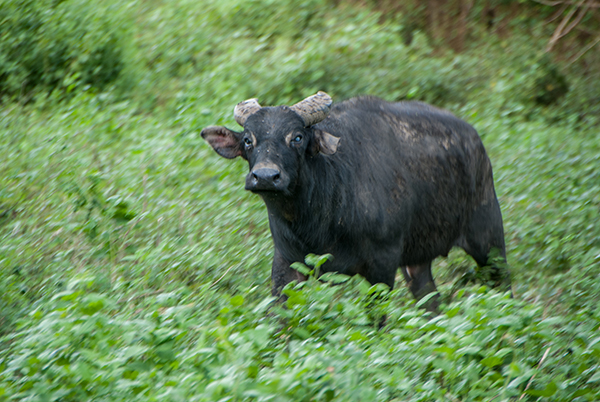
“A future with multiple populations of tamaraw across Mindoro will mean this iconic wild cattle species has the greatest chance of long-term survival,” said James Burton, chair of the International Union for Conservation of Nature Species Survival Commission Asian Wild Cattle Specialist Group and associate conservation scientist for Global Wildlife Conservation. “The ambitious recovery program will be a model for the conservation of other species across the Philippines and, if all goes according to plans, could be one of the world’s greatest conservation success stories in the coming years.”
Tamaraw are the Philippines’ proposed national land animal and listed as a critically endangered species on the IUCN Red List of Threatened Species. They stand at about 4 feet at the shoulders and charge when frightened. Only about 500 individuals are left on Mindoro Island—the only place the species lives—80 percent of which are found in Mounts Iglit-Baco Natural Park. The two other known populations on the island are small with only about 50 and 12 individuals—and without conservation measures would likely go extinct in the next few decades.
The newly developing plan for tamaraw conservation draws on recent tamaraw distribution and population data. The plan will address the primary threats to the species by ensuring zero poaching of the animals, working with ranchers to prevent the spread of disease from domestic cattle to the tamaraw, managing invasive species such as the plant shrub Chromolaena odorata, and collaborating with the indigenous communities to manage their land in a way that integrates their cultural and development needs with the recovery of the tamaraw.
The draft National Tamaraw Conservation Action Plan is the product of a Population and Habitat Viability Assessment (PHVA) workshop conducted on the first week of this month, 22 years after the last PHVA for tamaraw. Since then, the population of tamaraw has grown from 150 individuals to more than 400 in Mounts-Iglit Baco Natural Park—where conservation recommendations from the last PHVA have been implemented. Because the population here has grown but is restricted to a small area, the team will be able to relocate some of these animals to start new populations and supplement small populations.
More than 70 individuals were part of the PHVA workshop. Participating organizations in the PHVA workshop included the Department of Environment and Natural Resources (Biodiversity Management Bureau, Tamaraw Conservation Program, Regional Office-MIMAROPA, PENR/CENR Offices and Protected Area Management Offices), the IUCN Species Survival Commission Asian Wild Cattle Specialist Group, Global Wildlife Conservation, the IUCN Species Survival Commission Conservation Planning Specialist Group, the D’ABOVILLE Foundation (DAF), Mindoro Biodiversity Conservation Foundation, Inc., WWF Philippines, Center for Conservation Innovation, and Philippine-Biofin Project.