
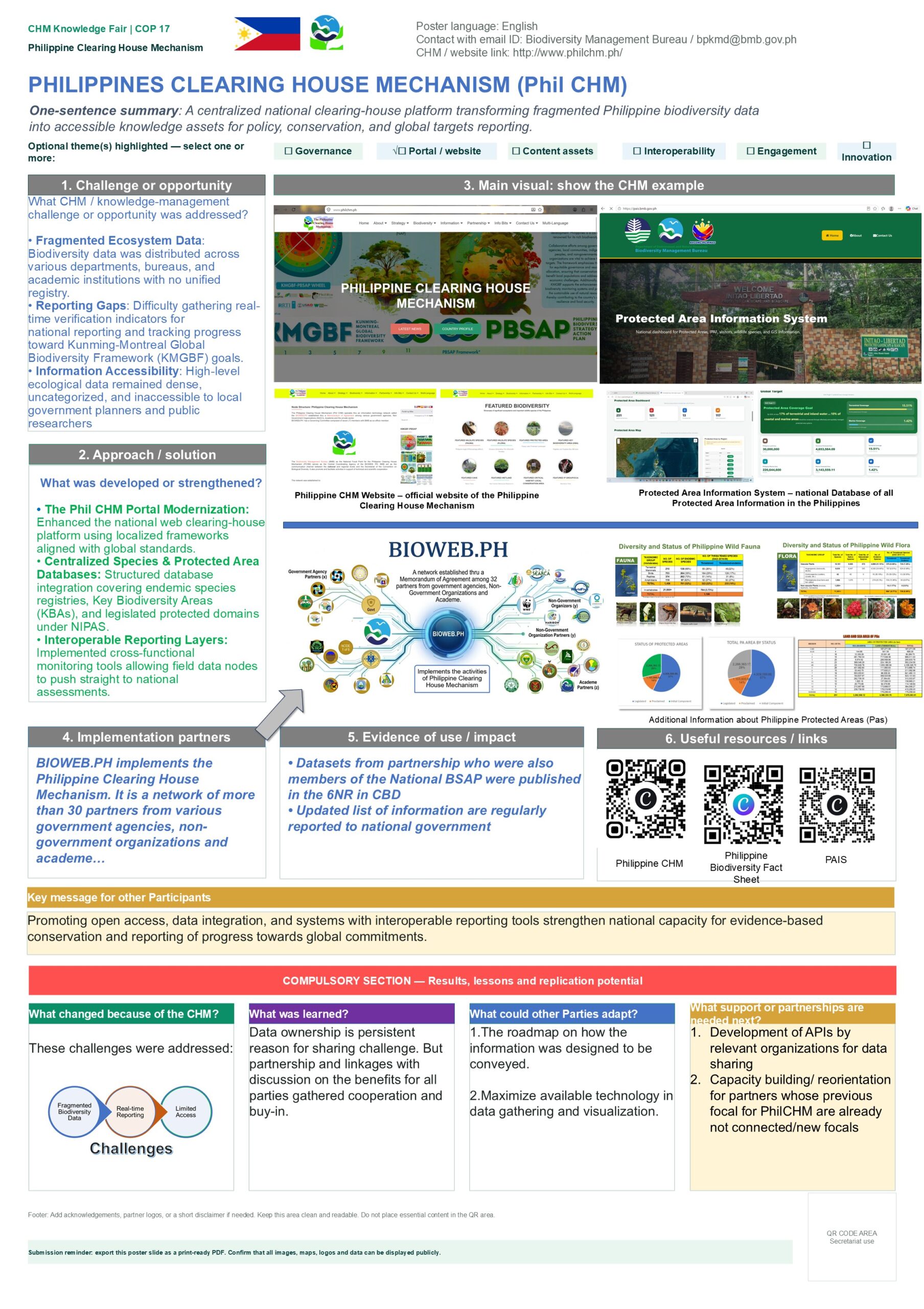
The poster presents the Philippines Clearing House Mechanism (Phil CHM), a national biodiversity information platform designed to consolidate and manage biodiversity data from multiple sources across the Philippines. Its primary goal is to transform fragmented biodiversity information into accessible knowledge resources that support conservation, policymaking, reporting, and monitoring of global biodiversity commitments.
Key Challenge Addressed
- Fragmented data spread across government agencies, academic institutions, and organizations.
- Reporting gaps, making it difficult to verify and track progress toward biodiversity targets, particularly the Kunming-Montreal Global Biodiversity Framework (KMGBF).
- Limited accessibility of ecological data due to inconsistent organization and categorization.
Approach and Solutions
The project addressed the above issues through:
- Modernization of the Phil CHM Portal
- Upgraded the national biodiversity information platform.
- Aligned with international standards and frameworks.
- Centralized Biodiversity Databases
- Integrated species and protected area information.
- Consolidated data on endemic species, Key Biodiversity Areas (KBAs), and protected areas.
- Interoperable Reporting Systems
- Created reporting layers that allow monitoring tools and field data systems to connect and feed information into national assessments
The poster highlights several key platforms:
- Phil CHM Website: The official biodiversity clearing-house portal.
- Protected Area Information System (PAIS): National database and information system for protected areas.
- BIOWEB.PH: A collaborative biodiversity network connecting over 30 government agencies, NGOs, and academic institutions.
- Biodiversity Fact Sheets and Wildlife Databases: Resources providing species and protected area information.
Partnerships
A major strength of the initiative is collaboration through BIOWEB.PH, which brings together:
- Government agencies
- Non-government organizations
- Academic and research institutions
Evidence of Impact
The poster reports that:
- Biodiversity datasets from partner organizations have been published and shared.
- Information is regularly updated and reported to national authorities.
- Access to biodiversity data has improved.
- Reporting has become more efficient and coordinated.
Key Message
The project demonstrates that:
Open access, data integration, and interoperable reporting tools strengthen national capacity for evidence-based biodiversity conservation and reporting of progress toward global biodiversity commitments.
Lessons Learned
- Data ownership concerns can hinder information sharing.
- Strong partnerships and clear communication help build trust and cooperation among data providers.
Recommendations for Other Countries
- Develop a clear roadmap for biodiversity information management.
- Maximize existing technologies for data collection, integration, and visualization.
Future Needs
The poster identifies two priorities:
- Development of APIs to improve automated data sharing among organizations.
- Capacity-building and on boarding of additional partner institutions into the Phil CHM network.
In One Sentence:
Phil CHM is a national biodiversity knowledge platform that integrates and shares biodiversity data across the Philippines, improving conservation planning, reporting, and collaboration among government, academic, and civil society partners